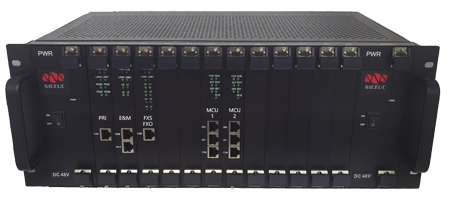
NC-DG2000 Series is NICEUC Communication’s next-generation integrated access device built for private network services. A single chassis consolidates every major communications interface, while its modular board design supports dual power supplies and dual master control units.
Hot-standby and hot-swap failover keep voice services running without interruption, and backplane cascading expands the platform by up to five sub-racks for smooth, on-demand capacity growth.
Widely deployed across IPCC, IP dispatch and unified communications environments, the NC-DG2000 is the ideal vehicle for private networks migrating smoothly from TDM to an all-IP architecture.
KEY CAPACITY METRICS | |||||
40 | 1200 | 80 | 10 | 40 | 80 |
E1/T1 Trunks | VoIP Channels | FXO/FXS Subscribers | ATS Q.SIG 3 channels | E&M Interfaces | Magneto Interfaces |
l High-availability redundancy: dual master control and dual power supplies with hot-standby and hot-swap failover. Voice services stay up through master control faults, link failures or planned maintenance.
l Flexible modular configuration: 10 service slots accept E1, FXO/FXS, ATS Q.SIG, E&M and magneto boards in any combination for true multi-purpose deployment.
l Smooth capacity expansion: backplane cascading expands a single host by up to five sub-racks, growing with your business on demand.
l Zero-disruption calling: dedicated voice capture interfaces with high-impedance parallel or mirrored output do not affect the primary voice channel or alter call state.
l TDM and IP convergence: E1/T1 signaling interworks with the PSTN while SIP/IMS connects IPPBX systems and SIP endpoints — no blind spots on the migration path.
l Flexible power options: power boards are available in 220V, 48V and 24V variants to suit a wide range of equipment room environments.
l Distributed, cascadable architecture: the host chassis can be extended by up to five sub-racks over the backplane, forming a distributed system in which processing and interfaces are spread across multiple frames while numbering, routing and management stay unified an efficient approach to scaling from a single equipment room to a multi-frame, multi-site deployment.
l Dual network ports: two 10/100/1000M Base-T Ethernet interfaces support redundant backup (automatic takeover if one link fails), traffic segregation (separate paths for signaling, media and management) and 802.3ad link aggregation, and can be assigned to different subnets or VLANs for flexible, secure network planning.
NC-DG2000 delivers a complete set of service capabilities on a modular architecture. From high availability, call control and signaling interworking to voice quality and operations management, every subsystem is engineered to carrier-grade standards to cover the critical requirements of private network access.
Dual-Master High Availability with Uninterrupted Service
Distributed Architecture for Frame-Level Scalability
Dual Network Ports for Redundancy, Segregation and Aggregation
Full Interface Board Family in One Chassis
Professional Call Control
Blacklist and Whitelist for Call Security
Rich Signalling with Seamless TDM-to-IP Interworking
Intelligent Routing with Manageable Traffic
Carrier-Grade Voice Quality and Fax
Voice Capture and Recording Monitoring
1. Protocols and Signalling
Protocol Category | Supported Specifications |
Signaling Protocols | SS7 (No.7 Signalling), PRI, R2 (No.1 Signalling), CAS, Q.SIG&ATS Q.SIG, V5.2, DPNSS |
VoIP Protocols | SIP, IMS |
Voice Codecs | G.711 U-Law / A-Law, G.711 Appendix I, G.729 Annex A / Annex B, G.726-16, G.726-32, iLBC, AMR |
Fax Protocols | T.30, T.38, fax pass-through |
Network Protocols | IP, NAT, ICMP, ARP, HTTP, BOOTP, FTP, TFTP, DHCP, SNMP, Diff-Serv |
Voice Processing | Voice Activity Detection (VAD), Comfort Noise Generation (CNG), G.168 echo cancellation (128 MS) |
2. Physical and Interface Specifications
Item | NC-DG2000 Specification |
Power Supply Slots | 2 (hot-standby and hot-swap capable) |
MCU Master Control Slots | 2 (hot-standby and hot-swap capable) |
Service Board Slots | 10 |
Cascading / Sub-racks | Backplane cascading, host frame plus up to 5 sub-racks (distributed multi-frame deployment) |
Analog Interfaces | 80 FXO/FXS ports |
VoIP Channels | 1200 |
E1 Trunk Interfaces | 0–40 E1 |
ATS Q.SIG | 0 to 10 (3 channels each) |
E&M Trunk Interfaces | 0–40 |
Magneto Interfaces | 0–80 |
Ethernet Interfaces | 2 × (10/100/1000M Base-T) |
Ethernet Port Modes | Redundant backup (automatic failover), traffic segregation (separate signaling / media / management paths), 802.3ad link aggregation, and independent subnet / VLAN assignment per port |
Serial Configuration Port | 1 × (RS232) |
Input Voltage | AC 110–240V (dual input) or DC 24V / -48V; power boards available in 220V / 48V / 24V variants |
Maximum Power Consumption | 120 W |
Telephone Line Transmission Distance | <10 km |
Dimensions | 480 mm × 300 mm × 178 mm (19-inch 4U standard rack) |
Weight | 10.5 kg |
Operating Environment | Temperature 0°C–50°C, relative humidity ≤ 80% |
Compatibility | CISCO, Siemens, AVAYA, Huawei, ZTE |
1. Positioning: NC-DG2000 sits between PSTN/PLMN and IP service platforms, acting as the gateway for signaling termination, voice aggregation and service delivery.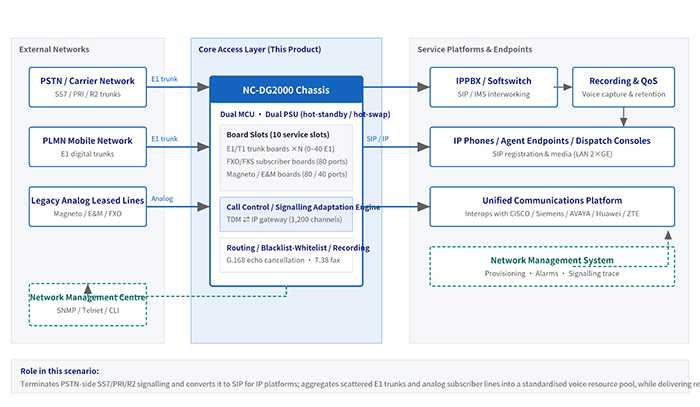
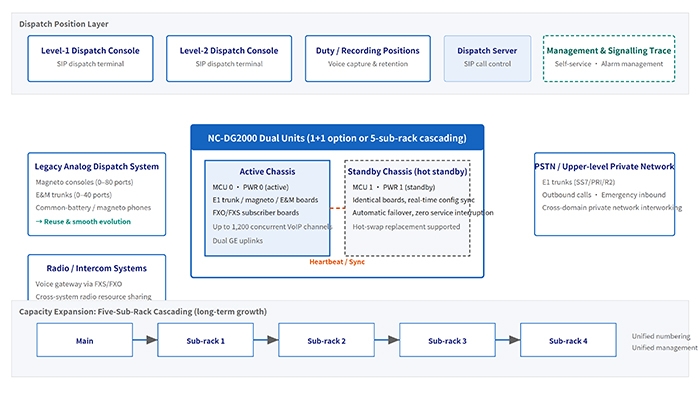
2. Positioning: NC-DG2000 is the aggregation hub of dispatch voice; dual MCU/PSU hot standby keeps dispatch commands flowing, while legacy magneto/E&M dispatch systems are reused.
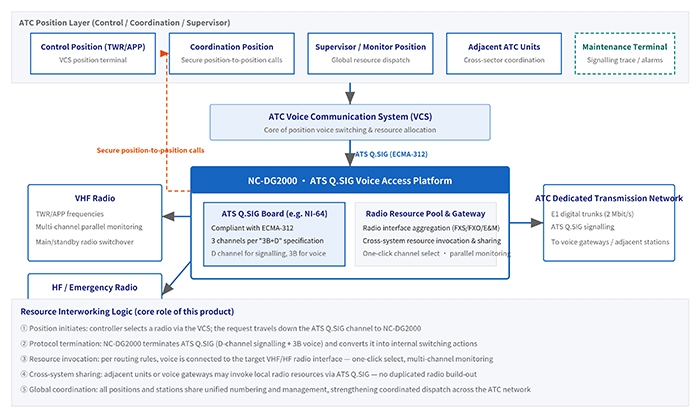
3. Positioning: via ATS Q.SIG (ECMA-312) digital trunks, NC-DG2000 joins the ATC-dedicated voice network as the core node interconnecting VCS, radio resources and controller positions.